
Benson's Blog
Benson's Blog
— An Overrated Factor: Rankings
University Rankings
US News dropped its rankings about a week ago. Times Higher Education released its world university rankings yesterday.
Here’s what I tell families I work with: rankings are a starting point for research, not a verdict on where your student will thrive.
A few reasons why:
1. Rankings measure the school, not the fit. A list can’t tell you whether a campus has the right classroom size, culture, or professors for your kid. Those things shape the four years far more than a number does.
2. Every list uses a different formula. US News and Times Higher Education weigh different things, so the same school can land in very different spots. If the “best” school changes depending on who’s counting, it’s worth asking what the number is actually telling you.
3. What a student does there matters more than where it ranks. The mentors they find, the research they join, the internships they land, the habits they build. A motivated student at a #40 school can outperform a coasting student at a #5 school.
4. Chasing rank can crowd out better options. I’ve seen students overlook schools with great programs and generous aid because they sat a few spots lower on a list.
None of this means rankings are useless. They’re a decent way to discover schools you hadn’t heard of. Just don’t let them make the decision for you.
The better question isn’t “How high is this school ranked?” It’s “Where will this student grow, feel supported, and do their best work?”
OCTOBER 1, 2026 · 2 min read


— An Overrated Factor: Rankings
University Rankings
US News dropped its rankings about a week ago. Times Higher Education released its world university rankings yesterday.
Here’s what I tell families I work with: rankings are a starting point for research, not a verdict on where your student will thrive.
A few reasons why:
1. Rankings measure the school, not the fit. A list can’t tell you whether a campus has the right classroom size, culture, or professors for your kid. Those things shape the four years far more than a number does.
2. Every list uses a different formula. US News and Times Higher Education weigh different things, so the same school can land in very different spots. If the “best” school changes depending on who’s counting, it’s worth asking what the number is actually telling you.
3. What a student does there matters more than where it ranks. The mentors they find, the research they join, the internships they land, the habits they build. A motivated student at a #40 school can outperform a coasting student at a #5 school.
4. Chasing rank can crowd out better options. I’ve seen students overlook schools with great programs and generous aid because they sat a few spots lower on a list.
None of this means rankings are useless. They’re a decent way to discover schools you hadn’t heard of. Just don’t let them make the decision for you.
The better question isn’t “How high is this school ranked?” It’s “Where will this student grow, feel supported, and do their best work?”
OCTOBER 1, 2026 · 2 min read


— An Underrated Factor: Climate
The California Sunshine
I woke up on a dorm room couch in Southern California, stepped outside, and immediately felt the warmth of the October sun. The sky was a flawless blue, without a cloud in sight. It was my senior fall, and I was visiting friends at the Claremont Colleges, so I assumed I had simply lucked into an unusually beautiful day. “Wow, it’s so nice out today,” I said to my friend. He laughed. “It’s like this year-round.”
At the University of Michigan, where I spent my undergraduate years, we get a window. Late August, September, and part of October are genuinely beautiful. Then winter arrives and doesn’t leave until finals week in April gives us one last tease of sunshine before summer break sends everyone home. For six or seven months of the school year, campus life happens indoors: in libraries, in dining halls, in dorms, anywhere you can escape the wind. You get used to it. You even stop noticing it. Just kidding, you don’t.
The dining halls at the Claremont Colleges spill outside; there are rows of tables where students eat lunch and dinner in the open air, not because it’s a nice day and everyone’s taking advantage of it, but because that’s just what a Tuesday looks like. People play pickleball and spikeball on the lawns. Others sprawl out on the grass with a laptop and a textbook, studying outside like it’s the most normal thing in the world, because for them, it is. I remember thinking, “I would be a genuinely happier person if this were my daily life for four years instead of ten minutes of sunshine between two indoor buildings.”
I started wondering what it would feel like to actually live that way. Over the past year, I’ve been fortunate enough to visit several more campuses across California: Stanford, UC Berkeley, Caltech, UC Santa Barbara, and USC. Each one reinforced the same idea from a slightly different angle.
Stanford felt less like a university and more like a country club that happens to grant degrees. The palm-lined paths, the manicured quads, and the sandstone archways of the Main Quad make a walk to class feel scenic. Berkeley had a different energy entirely: hillier, denser, more urban, with Sather Gate and the eucalyptus groves giving it a wilder, more collegiate feel, but still warm enough that students were doing parkour on the steps of Doe Library in shirtsleeves. Caltech, by contrast, is tiny and almost secretive; it’s a small, beautiful campus tucked into Pasadena, where the scale makes it feel more like a research village than a sprawling university. Students worked outside in nearly every courtyard I passed, and a pond near the center of campus had at least a dozen turtles swimming around. UC Santa Barbara might have been the most dramatic example of all: there is, quite literally, a beach on campus. Lecture halls sit a few hundred feet from the Pacific. Their library is split into two main sections along a central outdoor walkway called the Paseo: the Mountain Side and the Ocean Side. And USC, right in the middle of Los Angeles, had that same year-round outdoor rhythm: students eating, studying, and hanging out across Alumni Park like it was any given day in June.
None of these schools are very alike academically, socially, or culturally. But they all shared something that Michigan, for all its strengths, simply cannot offer: a campus life that unfolds outside, consistently, for four straight years.
I want to be careful here, because this isn’t a case for “warm weather schools are better.” Plenty of students thrive at Michigan, or Cornell, or Dartmouth, or any school that gets a real winter. Some people love the seasons, love the coziness of a snowy campus, love the built-in excuse to hole up in a library with a hot drink and focus. There’s a version of college happiness that looks like that too. But it is also true that “beautiful campus” and “great weather” often get treated as a secondary detail in the college search, something you notice on a visit and then forget about once you’re comparing rankings and majors and financial aid packages. My Claremont morning, and the months of visits that followed, convinced me that climate deserves more weight in that conversation than it usually gets.
September 14, 2026 · 5 min read
Stanford


UC Berkeley


Caltech


UC Santa Barbara


USC
— An Underrated Factor: Climate
The California Sunshine
I woke up on a dorm room couch in Southern California, stepped outside, and immediately felt the warmth of the October sun. The sky was a flawless blue, without a cloud in sight. It was my senior fall, and I was visiting friends at the Claremont Colleges, so I assumed I had simply lucked into an unusually beautiful day. “Wow, it’s so nice out today,” I said to my friend. He laughed. “It’s like this year-round.”
At the University of Michigan, where I spent my undergraduate years, we get a window. Late August, September, and part of October are genuinely beautiful. Then winter arrives and doesn’t leave until finals week in April gives us one last tease of sunshine before summer break sends everyone home. For six or seven months of the school year, campus life happens indoors: in libraries, in dining halls, in dorms, anywhere you can escape the wind. You get used to it. You even stop noticing it. Just kidding, you don’t.
The dining halls at the Claremont Colleges spill outside; there are rows of tables where students eat lunch and dinner in the open air, not because it’s a nice day and everyone’s taking advantage of it, but because that’s just what a Tuesday looks like. People play pickleball and spikeball on the lawns. Others sprawl out on the grass with a laptop and a textbook, studying outside like it’s the most normal thing in the world, because for them, it is. I remember thinking, “I would be a genuinely happier person if this were my daily life for four years instead of ten minutes of sunshine between two indoor buildings.”
I started wondering what it would feel like to actually live that way. Over the past year, I’ve been fortunate enough to visit several more campuses across California: Stanford, UC Berkeley, Caltech, UC Santa Barbara, and USC. Each one reinforced the same idea from a slightly different angle.
Stanford felt less like a university and more like a country club that happens to grant degrees. The palm-lined paths, the manicured quads, and the sandstone archways of the Main Quad make a walk to class feel scenic. Berkeley had a different energy entirely: hillier, denser, more urban, with Sather Gate and the eucalyptus groves giving it a wilder, more collegiate feel, but still warm enough that students were doing parkour on the steps of Doe Library in shirtsleeves. Caltech, by contrast, is tiny and almost secretive; it’s a small, beautiful campus tucked into Pasadena, where the scale makes it feel more like a research village than a sprawling university. Students worked outside in nearly every courtyard I passed, and a pond near the center of campus had at least a dozen turtles swimming around. UC Santa Barbara might have been the most dramatic example of all: there is, quite literally, a beach on campus. Lecture halls sit a few hundred feet from the Pacific. Their library is split into two main sections along a central outdoor walkway called the Paseo: the Mountain Side and the Ocean Side. And USC, right in the middle of Los Angeles, had that same year-round outdoor rhythm: students eating, studying, and hanging out across Alumni Park like it was any given day in June.
None of these schools are very alike academically, socially, or culturally. But they all shared something that Michigan, for all its strengths, simply cannot offer: a campus life that unfolds outside, consistently, for four straight years.
I want to be careful here, because this isn’t a case for “warm weather schools are better.” Plenty of students thrive at Michigan, or Cornell, or Dartmouth, or any school that gets a real winter. Some people love the seasons, love the coziness of a snowy campus, love the built-in excuse to hole up in a library with a hot drink and focus. There’s a version of college happiness that looks like that too. But it is also true that “beautiful campus” and “great weather” often get treated as a secondary detail in the college search, something you notice on a visit and then forget about once you’re comparing rankings and majors and financial aid packages. My Claremont morning, and the months of visits that followed, convinced me that climate deserves more weight in that conversation than it usually gets.
September 14, 2026 · 5 min read


— Fit Over Prestige
LeBron James
LeBron didn't choose the Sixers because they're the most prestigious franchise.
He chose them because he believes they give him the best chance to win.
High school students should think the same way about college.
Too many applicants build their college list around one question:
"What's the highest-ranked school I can get into?"
A better question is:
"Where will I have the best chance to succeed?"
The "best" college isn't the one that impresses strangers.
It's the one where you'll:
1) Build meaningful relationships with professors.
2) Find mentors who invest in your growth.
3) Have opportunities to lead instead of waiting your turn.
4) Access internships, research, and experiences that align with your goals.
5) Be happy enough to thrive academically and personally.
The college admissions process has convinced many students that getting in is the finish line. It isn't.
Graduating with the skills, experiences, and network to build the life you want- that's the finish line.
LeBron has spent his entire career making decisions based on fit and opportunity, not just brand names.
Students should do the same.
Prestige might open a door.
Fit determines what happens after you walk through it.
JuLY 24, 2026 · 2 min read


— Motivation
The Weight of a Name
My name is Benson Lu, and my company is called Lu College Consulting.
The name is simple. It’s easy to remember, and it tells people exactly who’s behind the work and the kind of service they can expect.
But to me, the name means something much deeper.
When you name a business after your family name, every piece of work becomes a reflection of it. Every essay I review, every college list I build, and every recommendation I make carries the Lu name. I’m not just representing my business; I’m representing my family and my ancestors.
That means I can’t cut corners. I can’t half-ass work. I can’t let down those who came before and are watching now. I have to put my best foot forward for every one of my clients. Lu College Consulting must represent the highest standard of excellence.
My grandfather was a high-ranking judge in China during a time when accepting bribes was common and, in many cases, expected. He refused. He continued living in the same modest, publicly subsidized apartment as the people who worked beneath him.
He passed away two weeks ago.
My father has carried that same quiet integrity throughout his life. He has always believed that doing the right thing isn’t about recognition; it’s about character.
I think about that often in my own work.
No one knows whether I read an essay once or three times. No one knows whether I spent another hour researching a college’s admissions trends instead of relying on generic advice.
But I know.
And the name of my business is the same name my grandfather and my father spent their lives honoring.
Now it’s my turn to honor it.
When families choose Lu College Consulting, they’re not just hiring someone to help with college applications. They’re trusting someone whose own name is attached to every recommendation, every edit, and every decision.
That’s a responsibility I take seriously.
Because a family name isn’t inherited once, it’s honored every day.
July 8, 2026 · 4 min read

— Motivation
The Weight of a Name
My name is Benson Lu, and my company is called Lu College Consulting.
The name is simple. It’s easy to remember, and it tells people exactly who’s behind the work and the kind of service they can expect.
But to me, the name means something much deeper.
When you name a business after your family name, every piece of work becomes a reflection of it. Every essay I review, every college list I build, and every recommendation I make carries the Lu name. I’m not just representing my business; I’m representing my family and my ancestors.
That means I can’t cut corners. I can’t half-ass work. I can’t let down those who came before and are watching now. I have to put my best foot forward for every one of my clients. Lu College Consulting must represent the highest standard of excellence.
My grandfather was a high-ranking judge in China during a time when accepting bribes was common and, in many cases, expected. He refused. He continued living in the same modest, publicly subsidized apartment as the people who worked beneath him.
He passed away two weeks ago.
My father has carried that same quiet integrity throughout his life. He has always believed that doing the right thing isn’t about recognition; it’s about character.
I think about that often in my own work.
No one knows whether I read an essay once or three times. No one knows whether I spent another hour researching a college’s admissions trends instead of relying on generic advice.
But I know.
And the name of my business is the same name my grandfather and my father spent their lives honoring.
Now it’s my turn to honor it.
When families choose Lu College Consulting, they’re not just hiring someone to help with college applications. They’re trusting someone whose own name is attached to every recommendation, every edit, and every decision.
That’s a responsibility I take seriously.
Because a family name isn’t inherited once, it’s honored every day.
July 8, 2026 · 4 min read
— Inspiration
Be Thankful You're the Underdog
After the New York Knicks won the NBA Finals, I couldn't stop thinking about Jalen Brunson.
In a game that rewards height above almost everything else, he was the best player on the court. By far. And he did it standing shorter than nearly every other player he faced.
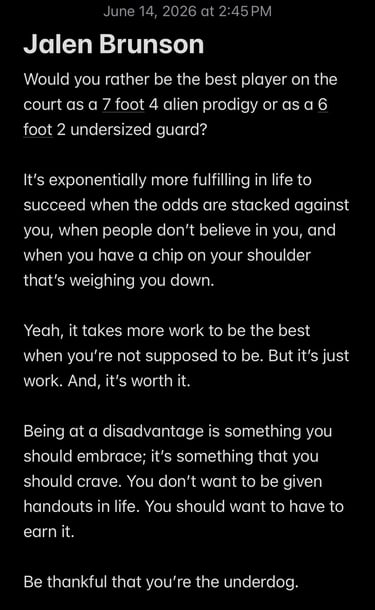
I opened my Notes app and started writing. Fifteen minutes later, I had this:
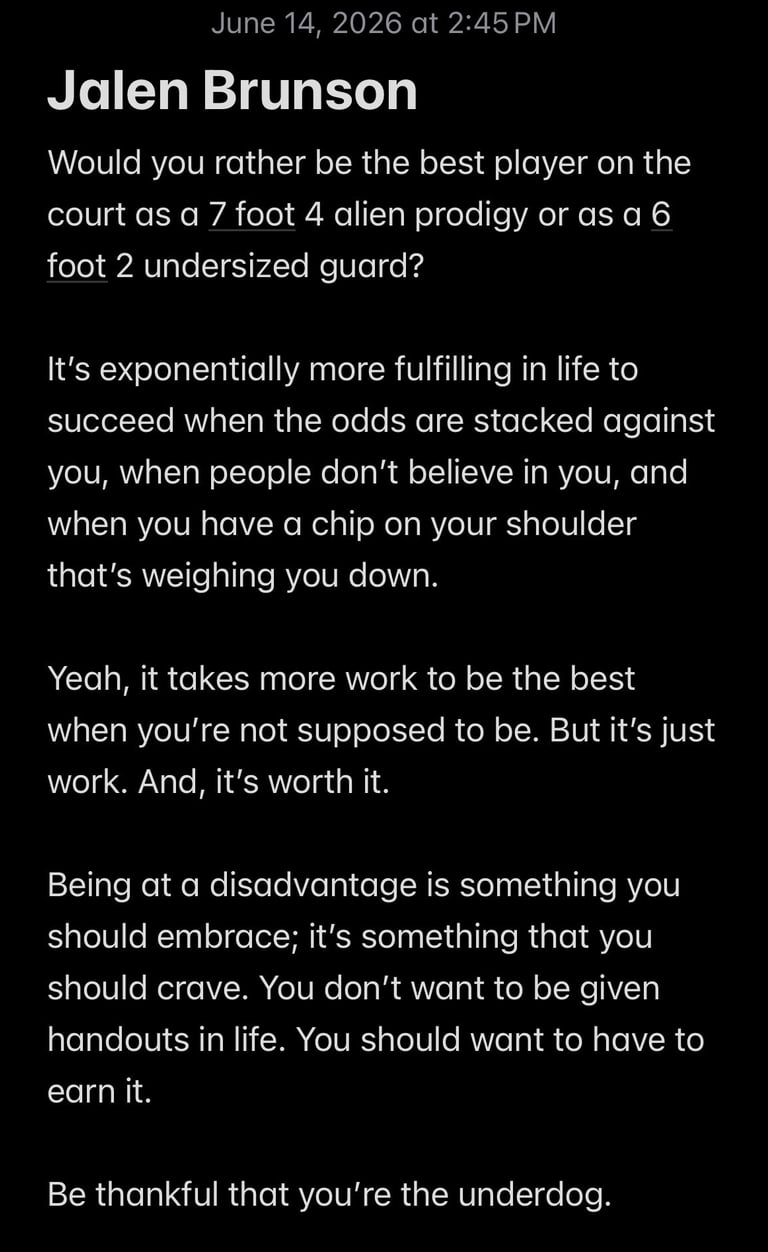
Would you rather be the best player on the court as a 7'4" alien prodigy or as a 6'2" undersized guard?
It's exponentially more fulfilling in life to succeed when the odds are stacked against you, when people don't believe in you, and when you have a chip on your shoulder that's weighing you down.
Yeah, it takes more work to be the best when you're not supposed to be. But it's just work. And it's worth it.
Being at a disadvantage is something you should embrace, something you should crave. You don't want to be given handouts in life. You should want to have to earn it.
Be thankful that you're the underdog.
I wrote that for myself. But the more I sat with it, the more I realized it applies to college admissions, too.
Most students I work with feel like the underdog. They don't have a 4.0. They weren't class president. They're applying to schools where plenty of other candidates look better on paper. And they wonder if any of it matters.
It does. Because a transcript is only part of the picture. Your essays, your demonstrated interest, the way you present who you are and where you're headed, those are the parts of an application you can actually shape. They're the parts that tell a story.
That's what we do at Lu College Consulting. We find that story and make sure it's being told clearly. You don't need everything to be perfect. You need the right person in your corner helping you put it together.
June 16, 2026 · 5 min read
— Inspiration
Be Thankful You're the Underdog
After the New York Knicks won the NBA Finals, I couldn't stop thinking about Jalen Brunson.
In a game that rewards height above almost everything else, he was the best player on the court. By far. And he did it standing shorter than nearly every other player he faced.
I opened my Notes app and started writing. Fifteen minutes later, I had this:
Would you rather be the best player on the court as a 7'4" alien prodigy or as a 6'2" undersized guard?
It's exponentially more fulfilling in life to succeed when the odds are stacked against you, when people don't believe in you, and when you have a chip on your shoulder that's weighing you down.
Yeah, it takes more work to be the best when you're not supposed to be. But it's just work. And it's worth it.
Being at a disadvantage is something you should embrace, something you should crave. You don't want to be given handouts in life. You should want to have to earn it.
Be thankful that you're the underdog.
I wrote that for myself. But the more I sat with it, the more I realized it applies to college admissions, too.
Most students I work with feel like the underdog. They don't have a 4.0. They weren't class president. They're applying to schools where plenty of other candidates look better on paper. And they wonder if any of it matters.
It does. Because a transcript is only part of the picture. Your essays, your demonstrated interest, the way you present who you are and where you're headed, those are the parts of an application you can actually shape. They're the parts that tell a story.
That's what we do at Lu College Consulting. We find that story and make sure it's being told clearly. You don't need everything to be perfect. You need the right person in your corner helping you put it together.
June 16, 2026 · 5 min read
Start with a conversation.
The first call is free and carries no obligation. Bring your questions about the process, your school list, or where to start; we'll figure out together whether this is the right fit.
Referral Program
Know a student who needs this?
The best way families find me is through people who already know and trust me. If you refer a friend, family member, or colleague whose student becomes a client, I'll send you $200 as a genuine thank-you. It's a small way of recognizing that your word is the most valuable endorsement I could ever receive.